
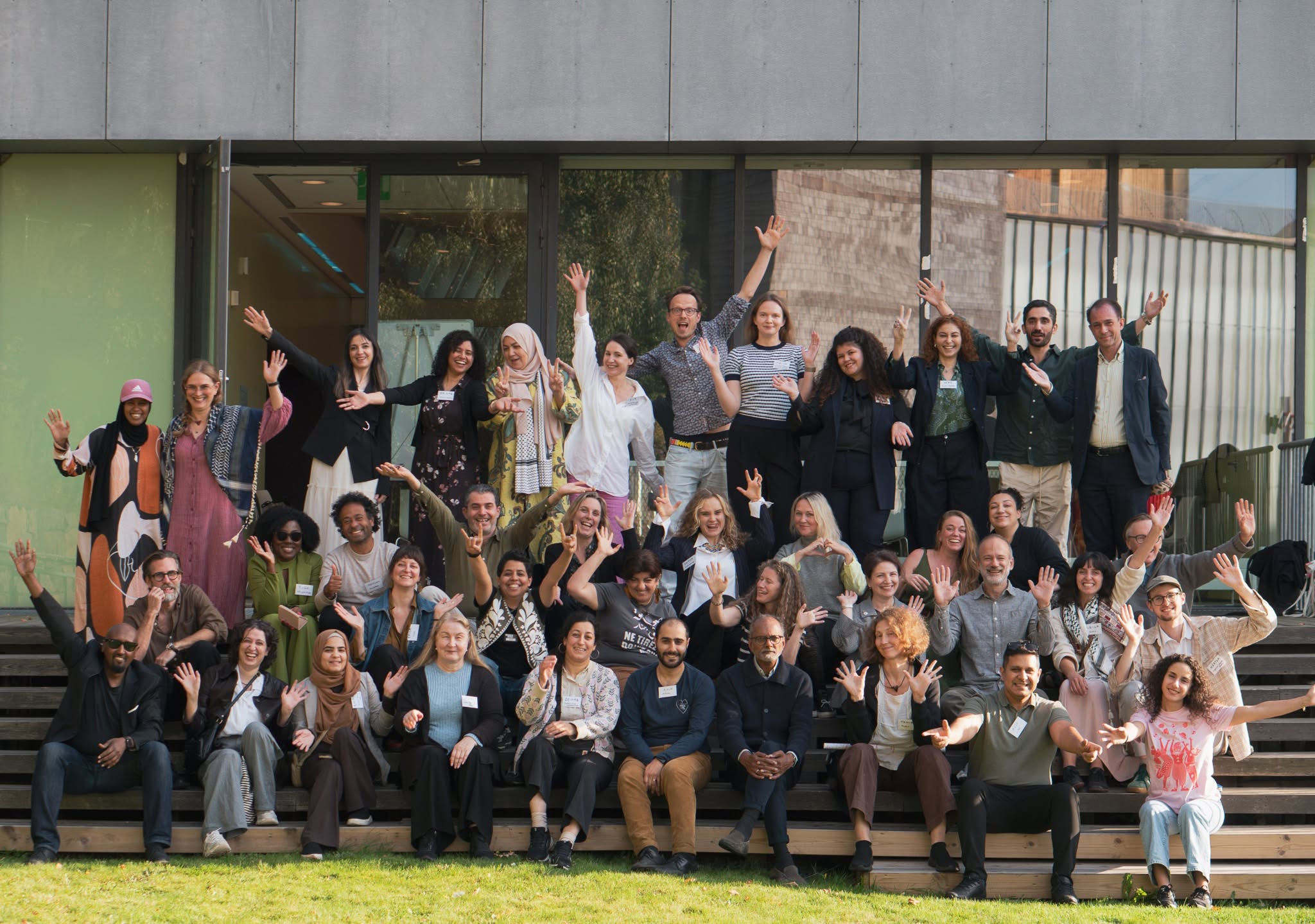
I got invited to participate in a 3-day forum and facilitate a workshop for the Swedish branch of the Anna Lindh Foundation, which is a Euro-Med network based in Egypt. The forum was called ‘Celebrating our Diversity’ and the theme this year was: ‘Democracy does not exist. We make it’. Perfect for what I do!
The gathering included around 45 people, many from Middle Eastern countries but mostly based in Sweden. I was the only Israeli.
On the morning of the second day, a woman shared that she felt very comfortable being in a group where she could truly be herself, wear her kaffiyeh and not worry about being judged. It triggered my own reflection about being there, which, although I was very comfortable being myself, I was also conscious that my very presence there may be triggering for some. It was why I was eager, in the first minutes of meeting new people, to quickly state where I was from, just to get it out of the way. Mostly it was well received with only one interaction feeling like just using the word Israel instead of Palestine already gave me minus points.
Because the organizer was herself Egyptian and had invited me there, I felt comfortable to start my workshop introducing myself and the method in the same way I always do. The method, Betzavta, comes from an NGO in Israel called the Adam Institute. I didn’t say too much about the NGO itself, but I shared things I always share at the beginning of such a workshop – discomfort will come, it’s part of the learning, and it’s actually the doorway to the learning. Also, the learning might not be wrapped up so neatly in the end like we are used to, because it’s an experiential process that sometimes takes more time to internally process.
And then I started. Working with a group of changemakers who deeply care about the state of the world is one of my favorite groups to work with, because they quickly see that they reproduce similar behaviors that they critique in the world. And many of them take this with good humor and reflection because generally it’s a group that values the process of becoming aware, especially self-aware. In the midst of reflecting on their own dynamics, a participant raised her hand and shared that she is still sitting with where I’m from and who the Adam Institute is and if she should even be in the room. She requested I talk a bit more about who the Adam Institute is and what kind of work they do. So I shared a bit about their work, and it seemed to be a relief, but there was also some emotion involved in her sharing, which triggered my own emotional center. I shared that it’s somewhat painful that there is a condition on being accepted as the facilitator, and in my perspective, a condition on giving a beneficial learning opportunity. That I first have to share what I’m against or what I condemn before the space could feel safe. It’s of course not the first time that I have felt this tension in these spaces, and I have written about it before (see my blog), but lately I’m more comfortable with not giving into another’s requirement for safety while sacrificing truth.
And maybe this is also a good place to ask – have we given too much power to the ‘safe space’? That as soon as someone feels unsafe, the rest of the group has to create the conditions to solve that for another person? And what makes it so unsafe, the possibility that you might be sharing a space, perhaps even learning from someone who thinks differently? And where does celebrating our diversity come if we are all required to position ourselves in the same way before we even start the learning process?
I don’t position myself in that way, because it doesn’t feel true for me. I do not stand for Israel nor Palestine, there are plenty of others fighting that fight. I stand for Truth. I stand for Peace. I stand for Love, powered by God. These are my motivators. So I align with those, and that is why I am able to work in many different spaces. Of course it’s not always easy, but there were plenty more in the workshop that greatly benefited and found it very insightful. I do it for them, and whoever else can receive the opportunity to truly celebrate diversity.
Still, it was intense, and I felt the emotional heaviness, and during the lunch break after, I noticed that the ripples spread to the bigger group, and some participants who did not even attend my workshop were affected. I didn’t know exactly what was going on, but I felt this had to do with my presence there, and this was confirmed after lunch when the organizer openly shared with the whole group that this “issue” of having an Israeli facilitator sharing her work is now present in the group. BUT, that we did not really have time to go into it.
It was interesting to be at the center like this, but I also did not take it personally. I know the pain on all sides. I know that pain is at the center of this whole thing. I know we need more healing spaces.
I did not see it as a situation that was wrong or needed to change. Uncomfortable, yes. For many in the group, including myself. I know there were projections about what I should say or not say or maybe even about inviting me in the first place. Or on the format for what should or shouldn’t be allowed. Some people even blamed time itself. But I don’t put my energy into how this situation could have been avoided. Or how can we get rid of the discomfort.
I feel everything was exactly the way it should be. That this is exactly the tension we need to deal with, and I can serve that role for this purpose. My workshop was called “Democracy in Action: Using Tension as Connection”, and it delivered exactly that. But everyone has their own part to play, and I can only offer the gift, not whether it is received.
Thank you to Anna Lindh Foundation Sweden for the invitation, and for all the beautiful interactions that I had with people who deeply care about humanity. I hope to come again, despite and with the complexities. 
pic by Rachel Koumparou